Connectors remain the crucial element


Dr Stephan Middelkamp
Position: General Manager Quality & Technologies
- Department: SSU QT
- Company: HARTING Stiftung & Co. KG

Andreas Huhmann
Position: Strategy Consultant
- Department: C+N Strategy
- Company: HARTING Stiftung & Co. KG
Smartphones charge via induction, we connect headphones and headsets to their respective end devices by way of Bluetooth and we transmit data via wireless connections such as WLAN and the like. Even if we can hardly imagine this in our supposedly wireless age, the device our consumer end device is connected to by way of its data connection actually has a connector to transmit the data further. And the path to the cloud and the data space involves countless connectors. And even today, even in the digital space, nothing works without a simple but crucial element: the connector.
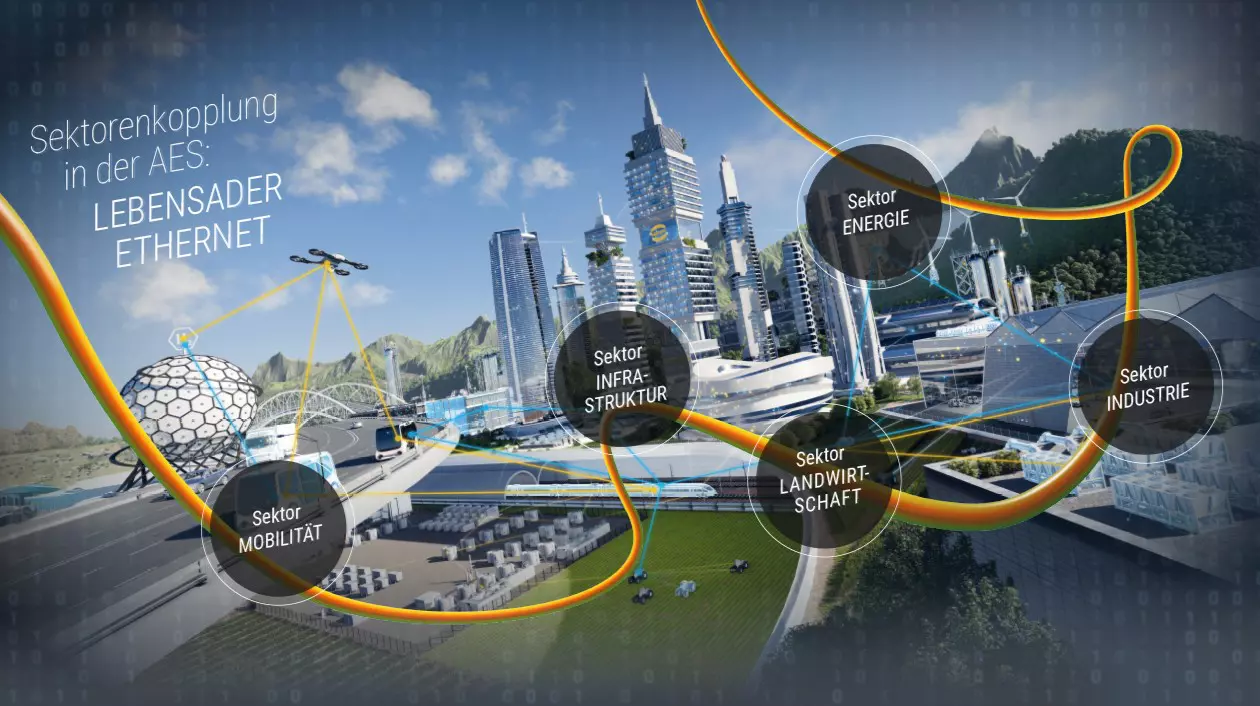
The notion that data connections are impossible without the right connectors is not just a technical truth. It also functions as a metaphor for the current challenges the All Electric Society is facing. At this point, sector coupling becomes the key issue (concept). But the concept of mere sector coupling actually falls short. After all, sector coupling ultimately extends far beyond just opening doors, i.e. simply overcoming the boundaries between sectors. Sector coupling calls for the far-reaching cross-sector interlinking of machines, systems and devices, including their sensors and actuators, which generate or consume energy in the various sectors in order to realise a genuinely networked electrical future.
Data networking is the foundation of the All Electric Society
The central core message of these considerations is that sector coupling should not only be perceived as a means of breaking down silos between energy, industry, mobility and other sectors. Rather, it is a comprehensive strategy aimed at integrating and networking the respective systems of different sectors in their depth and thereby creating a convergent platform in terms of data technology. This is because energy must be consumed precisely when it is produced. This requirement means that we have to analyse and interlink the various sectors in greater depth in order to ensure efficiency and sustainability.
In the physical layer, networking is extremely far advanced thanks to the universal use of Ethernet. Its use here looks back on a decades-long history, which was initially characterised by the fact that different profiles were opted for, which differed in terms of the connector. This was initially due to the given application, as each automation profile, for example, represented a self-contained ecosystem. Today, the situation is entirely different. Ethernet according to IEEE is adhered to as the standard. This means that devices can be used universally, even in different sectors – but naturally, only if the connector also fits the purpose.
Uniform, standardised data networks support integration within the sectors - and integration beyond the sectors. Both are of crucial significance for the success of the All Electric Society.
Standardisation, both on the physical and electromechanical layer, is becoming a crucial tool to support this integration. By creating broad, extensive standards for connectors, we are enabling seamless communication and interaction between the sectors. This delivers two benefits: On the one hand, there are advantages for users, who benefit from greater compatibility, scalability and interchangeability, for example, as well as a reduction in lock-in effects and maintenance input and costs. On the other hand, new possibilities arise in the use of decentralised end devices, which can be universally integrated in many sectors through standardised data interfaces, both physically, as well as electromechanically. This leads to innovation and dismantles old silos.
Openness instead of retreating
Protectionism is a prominent problem of the present day, which often hinders progress. Breaking down silo thinking and promoting an open, integrative approach to sector coupling are crucial factors. Instead of protecting existing structures, we should work on establishing harmonious cooperation between the sectors, enabling synergies to be leveraged and innovation-friendly framework conditions to be created and put in place. The convergence of the physical layer must go hand in hand with the convergence of the electromechanical layer. For example, when we develop new technologies and systems that are able to work more efficiently and in a more environmentally friendly manner at the same time, appropriate interfaces and connections are required.
The need for data rooms is another key element supporting sector coupling over the long term. Data rooms provide a structured framework in which data can be effectively shared and find use. This not only promotes transparency and efficiency, but also enables the development of solutions that will benefit all sectors. If, for example, data from the energy generation sector flows into industry or mobility, the entire value chain can be optimised as a result.
Crossing borders in the best meaning of the word
It is important to emphasise that sector coupling is not an additional task, but the logical and necessary result of consistent and converging digitalisation. The merging of data, technologies and processes is not only desirable, but essential in order to master ecological and economic challenges. We need to cross borders in the best sense of the word; after all, we are not merely bridging physical or technical boundaries, but creating new connections enabling us to work intelligently and utilise resources expediently.
A multitude of interfaces to the real world are crucial in order to achieve this. For example, edge devices are necessary within the context of the Internet of Things so that the data can enter the data room. But data will only arrive there if the right connectors are in place.
We are on our way to the All Electric Society. Comprehensive networking, supported by data standards and open interfaces, is the key to mastering the challenges of our times and shaping a sustainable, climate-neutral future.
Get involved in shaping the tec.news!
Your feedback helps us to tailor the magazine even better to your interests and needs.