Data helps success grow

Norbert Schlingmann
Position: Managing Director of the Agricultural Industry Electronics Foundation (AEF)
Digitalisation has changed agriculture fundamentally over the last two decades. Today, machines are no longer merely mechanical tools, but networked participants in the digital ecosystem. The AEF (Agricultural Industry Electronics Foundation) is facing the challenge of enabling data exchange between a wide variety of players and systems, while protecting the interests of farmers and machine manufacturers.
From machines to networks – the evolution of data exchange
Initially, the focus was on transmitting data within the machine. With the introduction of GPS systems and ISOBUS terminals in the 2000s, external data exchange became increasingly significant. Today, machines are part of a network, often within a corporation and in a closed cloud environment.
The role of standards and cooperation
The diversity of electronics and the volumes of data collected necessitate the further development of ISOBUS towards faster transmission paths and therefore also towards new standards. This requirement and international cooperation with other industries such as earth moving, mining and truck & trailer resulted in the creation of ISO Joint Working Group 16 (JWG 16). In this international working group, experts from various industries are working on the development of High-Speed ISOBUS geared to taking electronic communication and data exchange between agricultural machines to a new level. The aim is to make data exchange between machines up to 4000 times faster, to standardise interfaces for camera systems, for example, and to facilitate data exchange – thereby creating the foundation for innovative services.
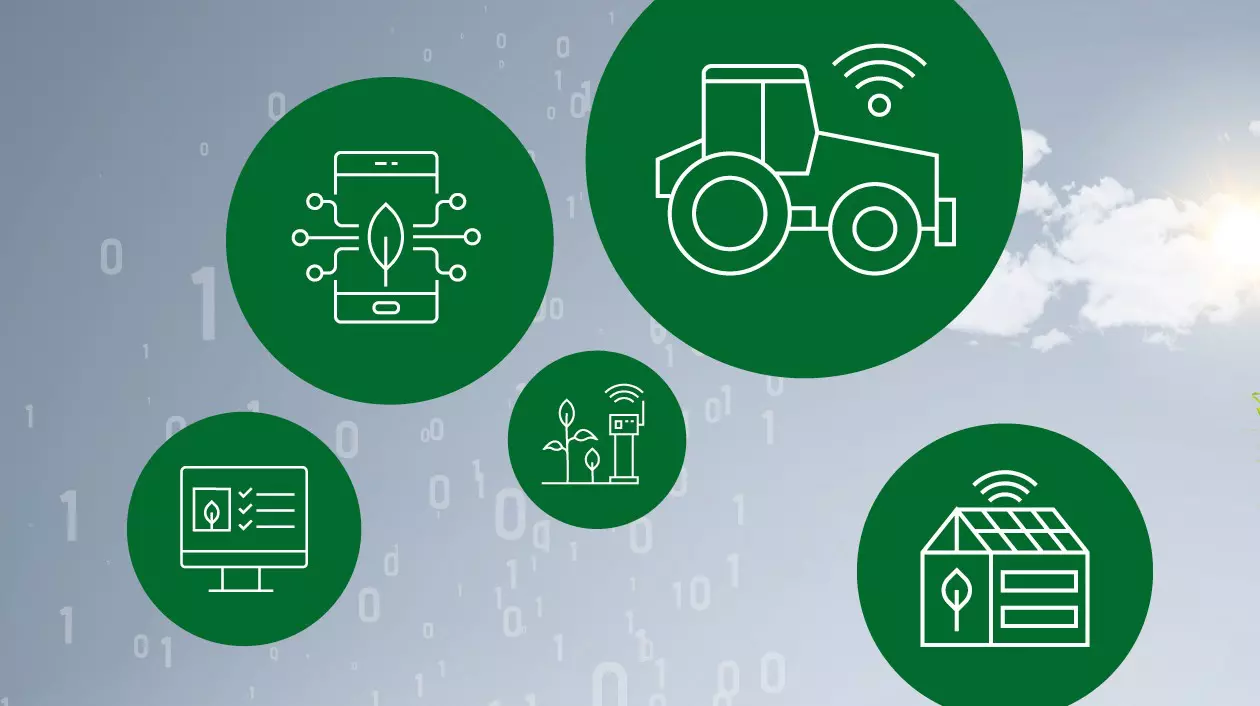
High Speed ISOBUS (HSI) uses 1000BASE-T1 Type B (Single Pair Ethernet, 1 Gbit/s, up to 40 m) according to IEEE802.3 as its physical transmission layer.
HSI is a further development of the classic ISOBUS standard in agricultural technology and enables significantly faster data transmission between tractors, accessories and attachments. This enables complex machine functions, large data volumes and modern assistance systems to be controlled more efficiently and in real time.
Data rooms as a model for the future
The development of open, cross-manufacturer data spaces represents a crucial step towards secure and efficient data exchange in agriculture. Proprietary cloud solutions reach their limits when machines from different manufacturers are at work. As part of the "Common European Agricultural Data Space", Europe is working with numerous partners on networked, legally compliant data spaces. In view of international developments, such as the planned establishment of 100 agricultural data rooms in China by 2028, Europe must remain competitive.
The future of agriculture is in the intelligent use of data. Transparent data spaces that enable exchange between different manufacturers and systems are crucial for innovation and sustainable production. Data management has become pivotal in agriculture and food production. Companies, from seed and chemical companies to food processors and agricultural consultants, use data to advance operational efficiency and enable precision farming. The exchange of data between different systems, however, is often inefficient and time-consuming. The AEF has recognised this need and developed the Agricultural Interoperability Network (AgIN) in order to create a harmonised data environment. AgIN promotes collaboration between members of the agricultural industry and enables peer-to-peer data connections. A legal framework and technical standards geared to improving interoperability are under development.
Only through cooperation, clearly defined legal frameworks and open solutions, which we are currently developing with AgIN, will we be able to master the challenges of data exchange and make agriculture fit for the future.
The AEF (Agricultural Industry Electronics Foundation) is an international, multi-vendor organisation with over 300 members dedicated to promoting and standardising electronics and software in agricultural technology. The AEF's goal is to ensure the interoperability and compatibility of machines, devices and systems from different manufacturers – in particular through the development and advancement of standards such as ISOBUS. The AEF brings together manufacturers, suppliers and other industry players to jointly develop solutions for the challenges of digitalisation and data exchange in agriculture. In this way, the AEF makes a significant contribution to driving innovation and increasing efficiency and sustainability in modern agriculture.
Get involved in shaping the tec.news!
Your feedback helps us to tailor the magazine even better to your interests and needs.