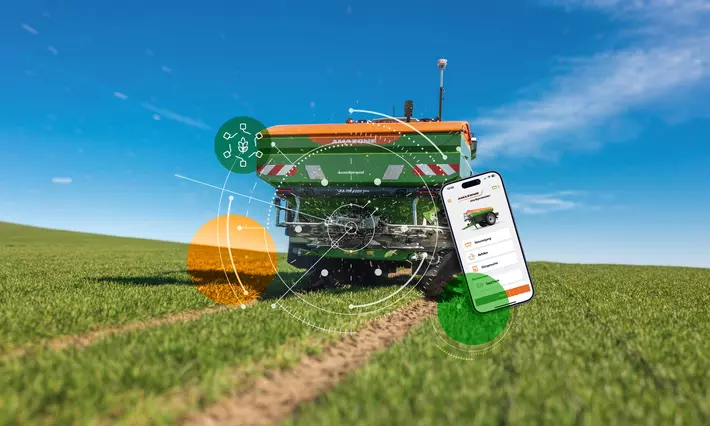
Making up ground in agriculture

Moritz Roeingh
Position: Managing Director
- Company: Competence Centre ISOBUS e.V.
The Competence Centre ISOBUS focuses on the practical implementation of digitalisation in agricultural technology. The aim is to support small and medium-sized manufacturers with technical solutions and targeted interest representation in the development and integration of modern ISOBUS based interfaces.
A key technological milestone is ISOBUS, which has been established as an international standard for over 20 years.

Moritz Roeingh
A great degree of diversity is encountered in the agricultural engineering sector: farmers use machines from different manufacturers and different methods of data collection – ranging from handwritten notes to automated, internet-based systems. In crop protection in particular, the spectrum extends from manual input to fully automated cloud transmission.
Standardisation originally set in with CAN bus-based systems and has been continuously developed ever since. Today, the industry is facing a transition to Ethernet-based solutions given that the demands and requirements for speed and data volume continue to trend upwards. Modern machines are equipped with numerous sensors whose data volume is pushing the CAN bus to its limits. Ethernet also enables the transmission of digital camera images, opening up new possibilities for machine operation and monitoring.
Proven IEEE standards are currently opted for in the Ethernet field. The future High Speed ISOBUS (HSI) relies on 1000BASE-T1 Type B (Single Pair Ethernet, 1 Gbit/s, up to 40 m) according to IEEE 802.3 as the transmission layer. HSI is based on the classic ISOBUS and enables significantly faster data transmission, so that complex machine functions and large data volumes can be exchanged efficiently and almost in real time between tractors and their accessories and attachments. The introduction of Ethernet technologies is also being driven forward in the interests of consistency, in order to simplify the use and further processing of data across different systems. With a look to the future, the industry is increasingly focusing on open standards that enable convenient integration and coupling with other sectors. Development is taking place in close cooperation with the Agricultural Industry Electronics Foundation (AEF), which coordinates standardisation worldwide and leverages synergies with other industries. This is not only an advantage but represents necessity in order to benefit from economies of scale and the widespread availability of components.
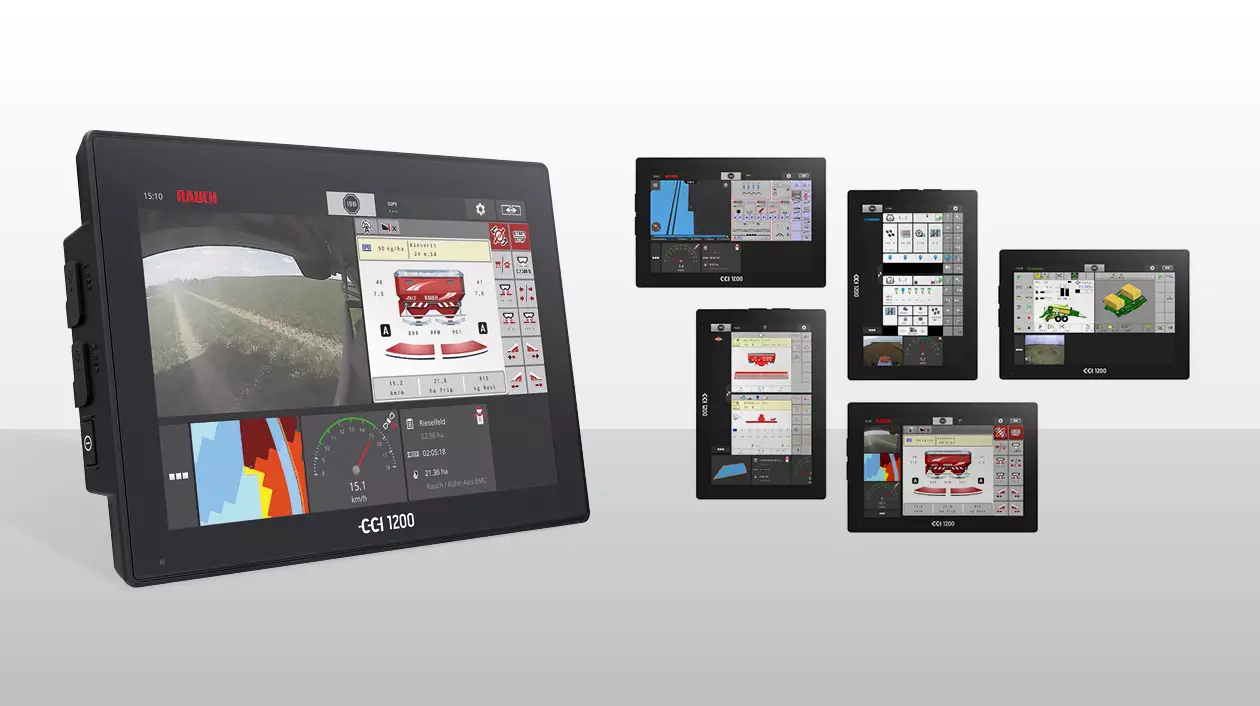
Copper-based Ethernet connections currently embody the state of the art, while wireless technologies such as WLAN are only deployed for connecting terminals to the internet. The development of Wireless Infield Communication has set in and focuses on wireless communication between agricultural machines and devices directly in the field. The aim is to exchange data such as the current coverage of a given area or track lines without a cable connection. Work is also underway on the transmission of video streams and the remote control of machines in order to be able to use platooning1 when transferring loads from the harvesting vehicle to the transport vehicle.
Standardisation is achieved through cooperation between the AEF and ISO, with the Competence Center ISOBUS e.V. representing the interests of SMEs and medium-sized manufacturers in particular. While the AEF further develops standards, the association pools expertise and jointly develops products for machine communication. This results in solutions that meet the requirements of modern agriculture while promoting innovation at the same time.
___________
1 Platooning refers to the automated, coordinated driving of several agricultural machines in close succession in order to carry out work processes such as sowing, harvesting or fertilising more efficiently and precisely.
Competence Center ISOBUS e.V.
The Competence Center ISOBUS is a cross-manufacturer association of SMEs and medium-sized agricultural technology companies. The joint development of software and components for the ISOBUS standard is the association’s key aim.
Get involved in shaping the tec.news!
Your feedback helps us to tailor the magazine even better to your interests and needs.