Automation is revolutionising agriculture

Josef Schmidt
Position: Managing Director digital workbench
What used to consist of clearly defined If‑Then processes is now being replaced by systems that recognise, evaluate and react to situations. This upheaval is particularly evident in agriculture – an environment characterised by variability, weather conditions, biology and unpredictable dynamics.
Today, progress in agricultural technology is taking place where selective, cognitive and autonomous functions are converging. New technologies enable the automation of tasks that were previously exclusively assigned to humans: whether apple harvesting, vineyard care or weed control – wherever individual decisions are required, AI‑supported systems are opening up new potential.
The motivation is clear: The sector needs greater precision in order to operate even more sustainably, while at the same time compensating for labour shortages. Automation is becoming a prerequisite for producing food in a resource-efficient manner – and in a specifically targeted manner rather than across the board. The basis for this is provided by technologies that are available today at prices that were inconceivable only ten or twenty years ago: powerful edge‑computer units, adaptive image processing or precision satellite receivers.
The change of perspective is remarkable:
The agricultural sector, which is often regarded as conservative, is making the highest demands on automation – and every plant is unique. Arable farming requires systems that can deal with living, heterogeneous organisms.

Josef Schmidt
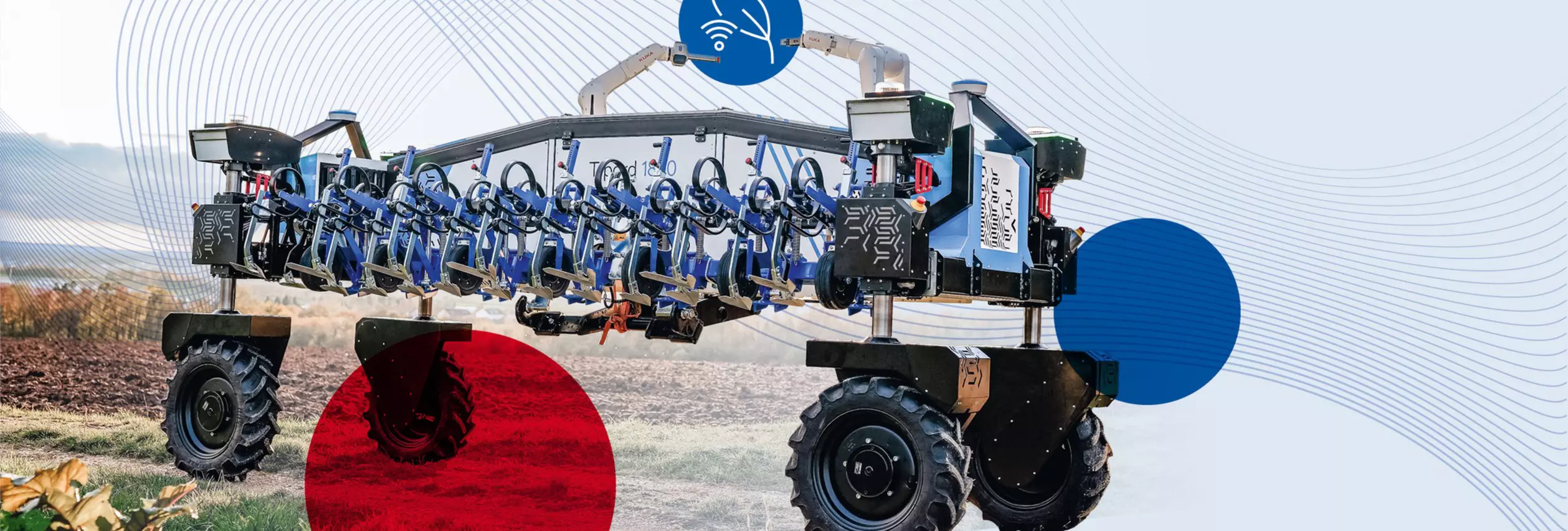
In this context, a new generation of multifunctional carrier platforms that serve as autonomous base vehicles is one salient example. Precise satellite navigation is ensuring tracking accuracy, while sensors record the machine status and surroundings. Building on this, camera-based AI‑modules work to analyse plant conditions, detect weeds or recognise growth parameters in real time. The evaluation is entirely decentralised on the machine – without cloud‑dependency.
The combination results in selective action: Mechanical tools remove weeds to pinpoint accuracy, while attached devices react differently to each plant. This makes autonomy a practical tool for resource-efficient management.
Electromechanics is one aspect that is often underestimated. In the field, however, most failures are not mechanical by nature, but electrical: corroded connectors, poor quality of crimp contacts, lack of strain relief. The electrical system is the central nervous system of the machine, and its quality directly determines availability and productivity.
Watertightness, media resistance, mechanical locking and robust strain relief are key requirements in this context. Connectors have to withstand high forces, vibrations and soiling, as well as high-pressure cleaning. Properly routed, relieved and protected cables reduce failures significantly.
These details are crucial for transferring automation from theory to stable, cost-efficient field operation. Accordingly, agriculture is demonstrating just how sophisticated and pioneering automation can be operating away from the factory: It combines ecological responsibility, economic necessity and technological innovation.
The future of automation will not only take place in the industrial park, but also on arable fields – where technology and nature meet and interact directly.
About digital workbench
Drawing on modular platforms and intelligent image processing systems, digital workbench develops practical solutions that work efficiently, robustly and in a resource-saving manner – thereby supporting machine manufacturers in implementing autonomy in everyday field work.