Autonomous production from order to delivery

Dr. Stephan Middelkamp
Position: General Manager Quality & Technologies
- Department: SSU QT
- Company: HARTING Stiftung & Co. KG

Thomas Kämper
Position: Head of Digital Prod. Systems Hub EMEA
- Company: HARTING Technology Group
Florian Raabe
Position: Expert Product Owner Manuf. Operations M
- Company: HARTING Technology Group
Martin Wischmeyer
Position: Project Engineer Operations
- Company: HARTING Technology Group

Mareike Knost
Position: Sr. Oper. Techn. Data Scientist
- Company: HARTING Technology Group
Autonomous production: HARTING on the way to a networked, flexible production
Autonomous production does not start at the machines, but with the customer orders. At HARTING, the tight integration of Enterprise Resource Planning (ERP), Manufacturing Operations Management (MOM), Product Lifecycle Management (PLM) and Autonomous Mobile Robots (AMR ) creates a fully digital end‑to‑end‑workflow interlinking all production and logistics steps.
The process gets off the mark in the ERP system, where customer orders are recorded and automatically converted into production orders. The ERP system prioritises these according to delivery dates and urgency. Subsequently, Manufacturing Operations Management (MOM) takes over operational control on the shop floor and translates the planning into executable work processes.
At the production level, MOM controls and steers the entire order processing:
Transparent order management:
MOM displays the status, material requirements and open process steps at all times.
Automated data flow:
production and quality data are reported back LIVE to the ERP.
LIVE‑Progress monitoring:
deviations, bottlenecks or waiting times become immediately visible.
Efficient material handling:
AMRs bring material to machines, transport semi-finished products and automatically store finished parts.
MOM automatically provides all the relevant technical documents – drawings, test plans or 3D‑models – from Siemens Teamcenter (PLM) and other sources. This means that employees are always working with the current and approved version.
Once production is complete, AMR once again take care of transport to the warehouse, while material movements are fully documented in the ERP and MOM. The subsequent delivery to the customer is managed by the European Distribution Centre (EDC): picking, packing, shipping and traceability are fully digitalised.
The medium-term goal of autonomous automation
The medium-term goal of autonomous automation is achieving a high degree of automation in production.
This extends beyond the automation of a single production step and includes the autonomous networking of various machines, including production planning and logistics processes. This enables achieving the optimum production point across the entire value chain. As production requirements are becoming increasingly volatile and individualised, loose interlinking and flexible software-supported control are essential.
For this autonomous automation process various elements are being implemented at HARTING:
A centralised manufacturing operations management platform networking the various systems and enabling optimal production planning.
The use of autonomous mobile robots for autonomous logistics processes for loading and unloading machines
The digital connection of all machines so as to ensure stable processes and control using real data
This will be enabled by the use of standardised OT infrastructures and software solutions – making processes more efficient, reducing sources of error and stepping up flexibility in production. Standardised systems also facilitate the integration of new technologies and ensure sustainable scalability of the production environment.
Manufacturing Operations Management (MOM) – at the heart of networked production
The MOM‑platform forms the central data hub of modern production operations. The platform networks machines, IT‑systems and manual input, thereby closing the gap that previously existed between the ERP/PLM‑world and the actual shop floor. This provides production operations with a continuous, reliable flow of information in real time.
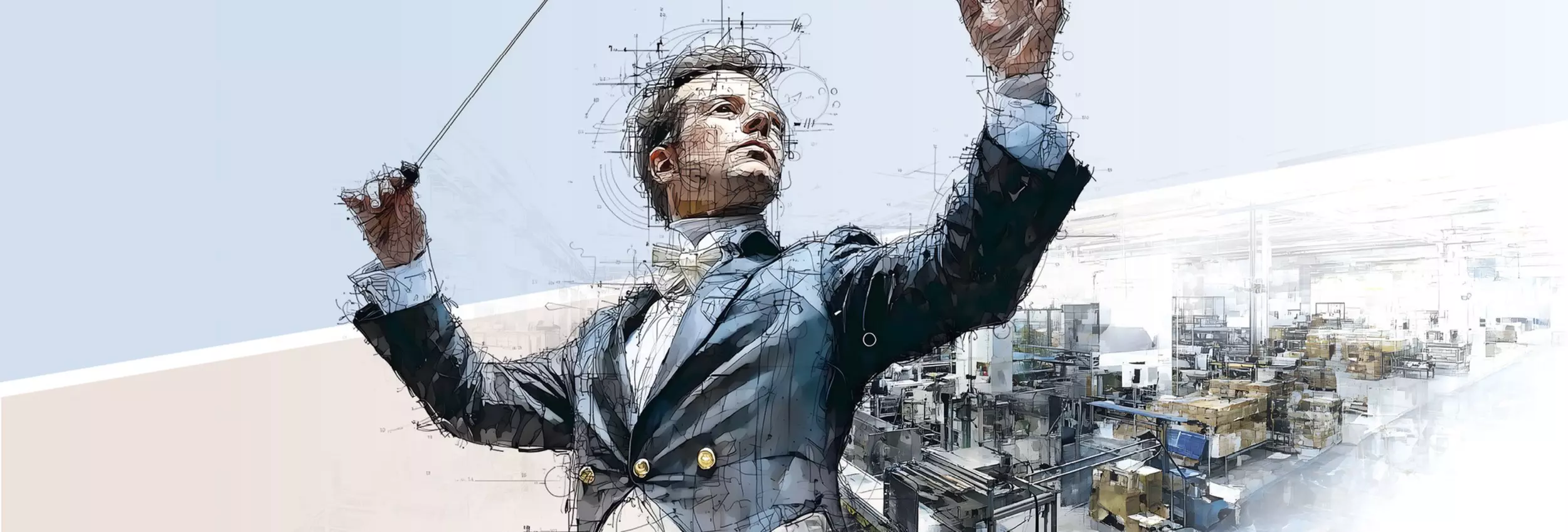
MOM takes on the role of a digital conductor: it synchronises orders, resources and material flows, detects deviations and automatically prioritises the next steps in the production process. As a result, processes become more stable, easier to plan and considerably more transparent.
The central functions include
Live‑Data acquisition and integration
from machines, ERP‑systems and quality processes
Control of order processing,
including status reports and material management
Availability and quality management
with real-time monitoring of vital resources
Data analyses and visualisations
that enable faster, objective decisions
For HARTING, the introduction of uniform MOM‑standards means global comparability of the plants, less manual coordination, faster response times and a scalable basis for autonomous production processes.
Concretisation using the example of AMR
In the above outlined manufacturing process, AMRs (Autonomous Mobile Robots) supply the machines with materials as required. Specifically, this means:
AMRs bring empties to the machines so that they can be filled with semi-finished products.
Subsequent to each processing step, the AMRs automatically transport the semi-finished products to the next relevant machine or directly to the central warehouse. All the respective processes for quality assurance, traceability and article and tub matching are controlled and implemented fully automatically in the background by our proprietary software modules.
After passing through the final processing station, the AMRs take the finished products to the warehouse, where they are prepared for dispatching.
This allows the material flow to be controlled flexibly, efficiently and automatically. Bottlenecks and waiting times are minimised as the machines are always supplied with material in good time and semi-finished products can be processed without delay.
By using defined and VDA5050-harmonised data exchange formats, a heterogeneous fleet of AMRs can be controlled with just one single central fleet management system. This means that different AMR models and manufacturers can be deployed in unison in a production environment without the need for a separate control system for each robot type. The standardised interfaces guarantee smooth communication and integration, significantly enhancing and increasing flexibility, scalability and efficiency in material flows.
In order to ensure a lean and efficient process and to meet global challenges, process-specific solutions are standardised for the individual handover situations in the various production departments. All the transfer stations and AMR superstructures are developed and manufactured in-house at HARTING, thereby enabling rapid response times and strategic processing worldwide.
Data transparency thanks to standards – from measured values through to added value
Accessibility of production data is a key element on the course to data-driven/autonomous production. In our OT‑area, we create the technical preconditions for this. The diversity of our machine landscape represents the major challenge here: different production technologies, different manufacturers and vendors, as well as systems spanning several decades mean that data is available in a wide variety of forms and formats. The connection of these machines is therefore complex, but represents a central issue. Only uniform interfaces and standardised formats will enable data transparency and the cross-system use of such data.
Based on this foundation, process data such as temperatures, pressure ratings, specific times or energy consumption can be analysed and evaluated. In this way, the pure measured values are transformed into meaningful information about the status and behaviour of our processes. This reveals whether machine processes are stable, whether trends are emerging or whether irregularities are occurring that would require closer examination. By monitoring and visualising the data, such deviations can be identified at an early stage and presented in a readily comprehensible manner.
The decisive added value is then created when this information is used to improve processes in a targeted manner. This can mean identifying the causes of fluctuations more rapidly or recognising the expedient levers where optimisation is possible. In this way, the structured evaluation of process data enables well-founded decisions and the continuous further development of our production processes.
Our goal is clearly set: Data should be transformed into information and this information into concrete benefits for production. This data-based approach lays the foundations for further steps towards achieving higher levels of automation and, over the long term, for more flexible, more stable and more efficient production – and perspectively for autonomous production.
Conclusion/Outlook
We are pursuing a two-dimensional strategy geared to fully realising this targeted status in all our plants. We have developed and validated a basic system and are gradually rolling this out to all our plants. In addition, we are developing and testing additional functionalities in pilot plants, which will then expand the basic system and benefit all plants. The expansion is taking place incrementally, step by step – in a site-specific, stable and sustainable manner.
It is decisive to consistently focus on standards and continuously implement them globally. Global benefits can only be achieved through the uniform application and further development of standards. This creates transparency, facilitates collaboration across locations and enables sustainable scalability and increased efficiency throughout the entire company.
In addition to the technical aspects, empowering colleagues to actively shape the upcoming change represents a key challenge. Changes in the organisation have a direct impact on employees and require targeted support and training. Consequently, HARTING is consistently pursuing the path towards autonomous, fully networked production and creating the foundation for globally harmonised production.