From product to process intelligence
Dr Volker Franke
Position: Managing Director HARTING Applied Technologies
How HARTING Applied Technologies is shaping and designing change in automation
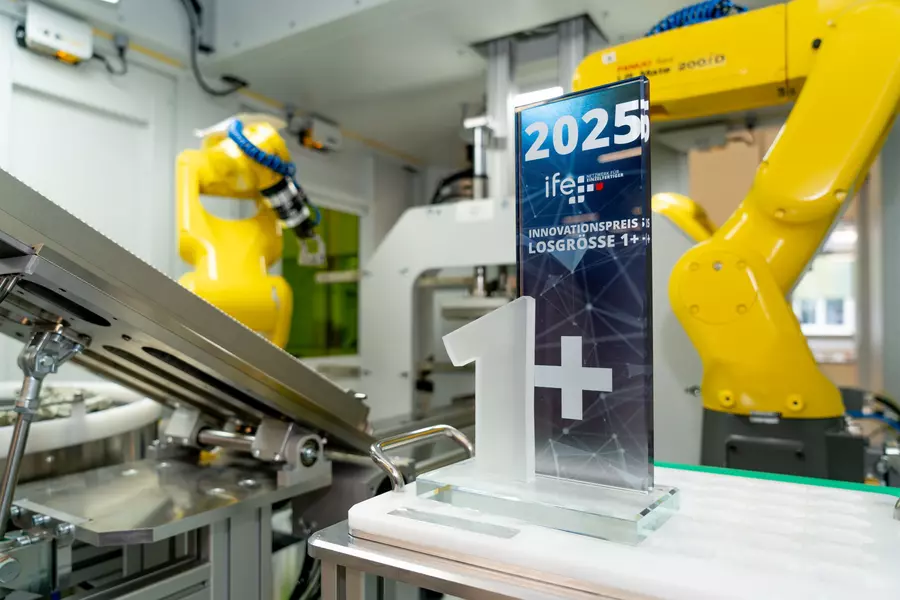
In the past year 2025, HARTING Applied Technologies was honoured with the prestigious "Batch Size 1+ Innovation Award" bestowed by the ife network on make-to-order manufacturers. And this success is no coincidence, but far more the result of a consistent reorientation in automation technology. The fundamental shift from a product-orientated to a process-orientated design of machines is the pivotal factor here. The modularisation and standardisation of mechanics, electrical engineering and control technology enables the efficient and flexible manufacturing of products involving many variants in smaller quantities – a decisive advantage in a globalised industry with increasingly individual customer requirements. The positive effects are clearly evident given optimised cost structures and shorter delivery times.
Systems engineering as the key
Engineering is undergoing fundamental changes in HARTING's special machine construction activities. Pursuing a holistic approach, systems engineering is combining and merging mechanics, electrical engineering and software. The motto here is: "Intelligence before steel". Where mechanical precision used to take centre stage, software is now increasingly handling and managing flexible tasks – such as camera-based inspections and corrections replacing mechanical solutions. Development work takes place in a team and is simulated in advance. The additional work involved in programming and commissioning is compensated for by virtual processes running parallel to mechanical engineering. Digital tools are indispensable here, for example to precisely describe the capabilities of individual process modules. The Asset Administration Shell (AAS) plays a central role in this context by reducing configuration and integration costs, overcoming translation difficulties between mechanical, electrical and control engineering and creating a complete digital image.
Development sets in already at the sales stage: Customer requirements are defined at an early juncture and seamlessly transferred to implementation. Process modules facilitate this process, as sales-relevant data is available right from the outset. The significance of software development is rapidly on the rise – shifting away from conventional PLC programming and towards complex IT tasks that enable deep integration into higher-level systems. This allows the orchestration of machines and systems, the digital support of maintenance and servicing, as well as the continuous data-based optimisation of production – which is understood as an overall system in which value-adding processes and intralogistics are automated and digitally integrated.
Challenges and solutions for the future
Despite all the progress that has been achieved, obstacles do remain. Efficient simulation tools and integrated engineering tools are just as much in demand as is engineering support for electrical and control technology commissioning. Artificial intelligence and machine learning must be integrated as easy-to-use tools in engineering, documentation and adaptive control tasks. The AAS should be supported across the board, as well as editor software enabling seamless collaboration. Cooperation platforms are necessary in order to overcome divergences in terminology and labelling between specialist areas – for example between electrical planning and PLC programming.
An example from actual practice: HARTING's assembly systems are designed along the lines of injection moulding machines. A basic system is flexibly customised with product-specific grippers and devices. The combination of hardware and software is the special feature here, which significantly elevates the degree of automation – also for low-volume products. The processes – such as feeding, assembly, labelling and packaging – are viewed as "skills" that can be easily adapted in a skills-based environment.
The future of manufacturing is flexible, intelligent and digital - and HARTING is playing an active role in shaping and designing this future.
HARTING Applied Technologies
HARTING Applied Technologies specialises in innovative solutions in the fields of toolmaking, special machine construction and automation technology areas. Drawing on many years of in-depth experience and high levels of engineering expertise, this business area of the HARTING Technology Group develops and manufactures customised production systems, precision tools and automation solutions for demanding industrial applications.