A look into the future of industrial intelligence


Prof. Dr. Martin Ruskowski
Position: Chairman of the Executive Board of SmartFactory-KL
We are at a genuine turning point in industrial evolution. While production systems are becoming more flexible and at the same time more complex, many companies continue to operate within structures that hark back to a bygone industrial era. Machines are highly reliable, but the actual intelligence of a factory – the ways in which information is created, flows and leads to decisions – is often fragmented.
It is time to rethink: What does a factory look like that would really be capable of acting independently? Not just in an automated, but autonomous way?
From automation to autonomisation – a fundamental change of perspective
Automation has been the backbone of industrial value creation for decades. But what does the term actually mean? I define it as follows:
Automation means replacing human behaviour with technical processes – processes that are reliable, reproducible and generally deterministic.

Prof. Dr. Martin Ruskowski
An automaton is a self-contained unit whose behaviour is fully described, predictable and dependent on clearly defined conditions. This form of automation was and is essential for efficiency, quality and safety.
The industrial context, however, is changing faster than automation can react. Variant diversity, volatile markets, dynamic supply chains and demographic change demand systems that not only execute, but also decide, adapt and interpret.
Autonomy therefore broadens the horizon
An autonomous system is capable of operating under uncertain and variable boundary conditions, making decisions over longer periods of time and stabilising itself – without constant human intervention.
A new scientific discipline is currently emerging, which we are building up in Kaiserslautern in co-operation with the local research institutes: autonomics. It combines automation technology, AI, computer science, social and legal sciences and is addressing the following question: How can we create machines, systems and factories that are capable of genuinely acting autonomously – safely, robustly and responsibly?
Demographic pressure is accelerating technological maturity
Consequently, autonomous systems are not a technological "add-on", but a social imperative.
Our future production systems will have to be able to do more because we will have fewer people to maintain and sustain them.
Prof. Dr. Martin Ruskowski
Change is not optional – it is necessary. In the coming years, an entire generation of experienced specialists will retire from the industrial arena. At the same time, demands and requirements are on the rise: sustainable production models, the circular economy, variable product portfolios and highly individualised supply chains.
Our architecture model for the autonomous factory – an open structure for a new industrial order
In order to enable the transition from today's production landscapes to autonomous factories, SmartFactory-KL has created an architectural model that is intentionally and specifically modular, open and brownfield-capable. It consists of three fundamental building blocks:
1. The digital backbone – the factory's memory and nervous system
Digital twins represent all relevant assets – machines, components, software modules, products or workstations. The backbone creates:
a uniform, standardised description of all production objects
the end of conventional data silos
a semantic information system that provides the right knowledge for every decision-making situation
It forms the basis for interoperability and machine understanding.
2. Automation – machine functions as modularised intelligence
Conventional automation thinks in terms of signals, cables and circuit diagrams. The factory of the future thinks in terms of functions.
Software-based encapsulation abstracts machine behaviour, resources and workstations in such a way that they can be used flexibly regardless of manufacturer or technology. This allows even decades-old systems to act as fully-fledged components of an autonomous system.
3. Agent systems – the motor cortex of autonomous production
Software agents assume active control roles:
Products know what should happen to them next
Machines know what they can do and when they will be available
Logistics systems dynamically plan optimal routes
This creates production logic that is no longer "commanded" centrally, but negotiated decentrally. Systems are organising themselves – and that is the core of true autonomy.
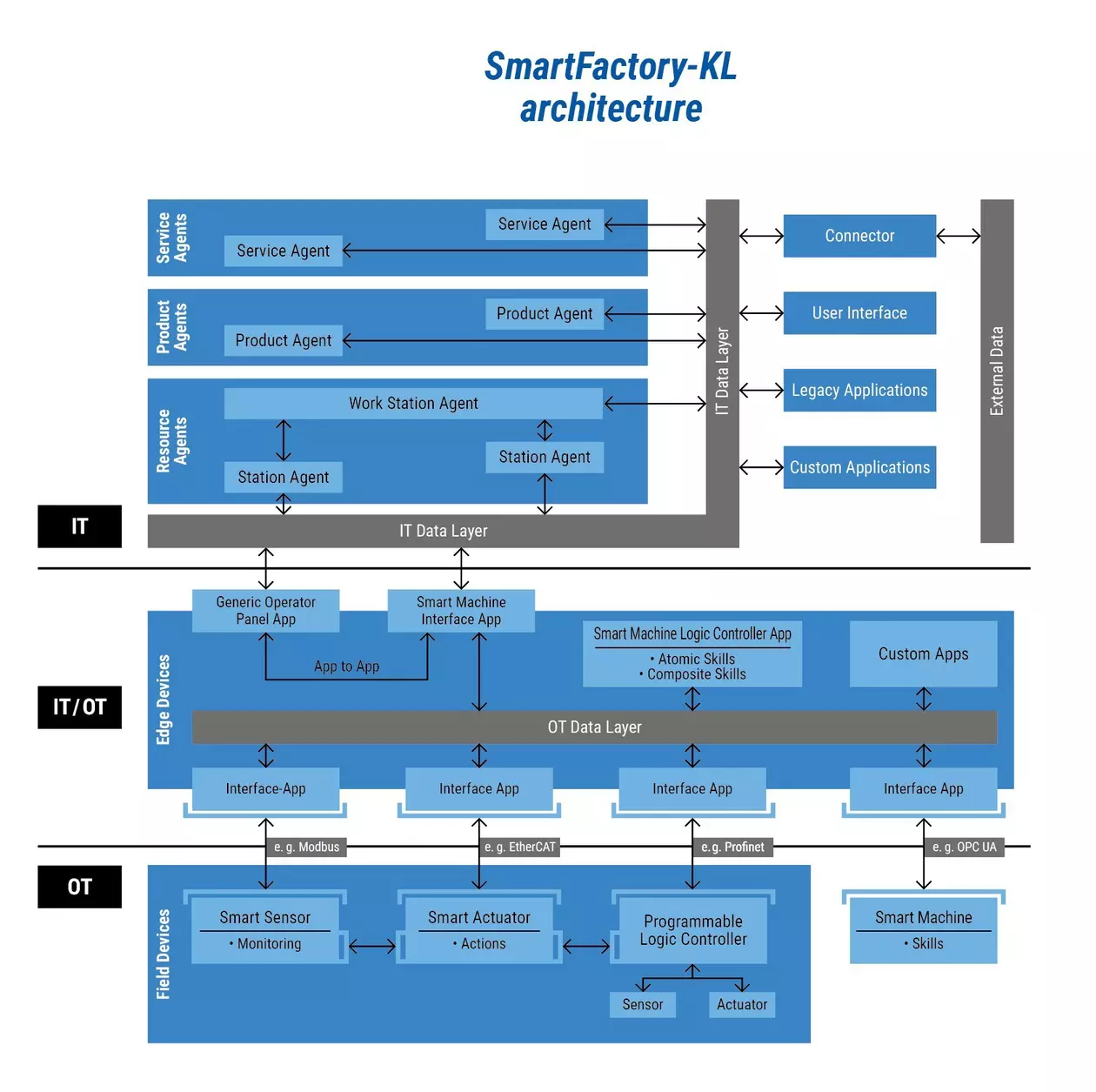
smartFactory-KL architecture model
Connectivity – the invisible fabric of autonomous systems
Autonomy needs information – comprehensive, precise and at an early stage. Digital twins enable transparency down to the depths of individual components. In future, even simple industrial connectors will provide data on mating cycles, loads or contact quality.
Many small sources of information all together create a highly intelligent overall picture – a principle borrowed from nature: Swarm intelligence.
About SmartFactory-KL
The SmartFactory-KL e. V. technology initiative, based in Kaiserslautern, is a leading German research and demonstration platform for future-orientated production systems. For over 20 years, the network of science and industry has been developing practical solutions for the factory of the future, focussing on modular production architectures, digital twins, interoperability and autonomous processes. The network serves as a testing ground for new technologies and standards and demonstrates how modern automation can also be implemented in the brownfield.