Smart charging: Unleashing the fullest potential of electric mobility


Dr Anica Mertins
- Company: National Coordination Centre for Charging Infrastructure
Bringing intelligence down to the field level
Why electric mobility can only unleash its fullest potential through data, communication and flexibility
Nowadays, electrification means far more than simply supplying devices with electricity. For a long time, electrical energy flowed in only one direction: from power stations to consumers. Electric mobility is now ushering in a significantly more complex system. Vehicles are becoming mobile energy storage units that can not only charge but, in future, will also feed electricity back into the grid.
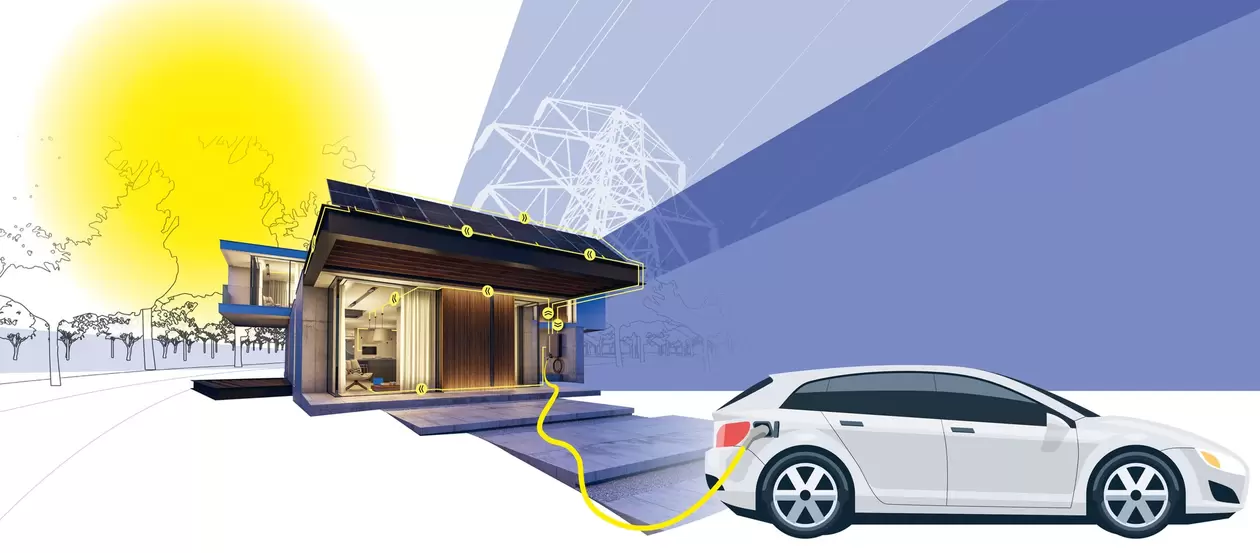
This change is particularly evident in bidirectional charging. In this scenario, an electric car is no longer used solely for transport, but can store surplus solar power, supply households or help to stabilise the energy system. This opens up new opportunities for consumers as well as for grid operators.
Source: National Charging Infrastructure Coordination Centre, NOW GmbH [ed.], (2024): Position paper on bidirectional charging enabling free of discrimination
Electrification needs digitalisation
Electrical energy alone, however, is not enough for all this to work. Modern electrification is virtually inconceivable without digitalisation. Vehicles, wall boxes, energy management systems and electricity grids must continuously exchange information – providing information on charge levels, available power, electricity prices and grid capacity. The more intelligent applications become, the more important data and standardised communication interfaces will be.
The aim is clear: Energy should be used when it is available and can be put to expedient and meaningful use. Instead of charging vehicles automatically in the early evening, when many people are returning home at the same time, charging can be postponed until times when solar or wind power generation is abundant. This unburdens the grids and improves the integration of renewable energy.
At the same time, new requirements are arising. Uniform standards are required to ensure that different vehicles, wall boxes and energy management systems work together reliably – considering that interoperable solutions are still lacking in many areas. Many systems currently only function within closed, proprietary ecosystems. For widespread market launches, devices from a wide range of manufacturers must be compatible and must speak the same langugae.
Data as the key to smart grids
In this context, the availability of data also plays a crucial role. When it comes to developing smart energy systems real-time information is absolutely essential. Only then can charging processes be automated and grid capacity utilised efficiently. Consequently, the key question is increasingly no longer whether sufficient electrical energy is available, but rather how generation, storage and consumption can be intelligently linked.
“Always on” – but energy-efficient at the same time
Moreover, there is another notable misunderstanding: “Always on” does not necessarily mean high energy consumption. Thanks to modern communication protocols, vehicles and charging infrastructures can be put into an energy-efficient sleep mode and reactivated only when necessary. Systems remain accessible without having to operate at full capacity all the time.
All of this should remain as invisible as possible to users. Over the long term, no one will need to decide manually when a vehicle is to be charged or can be uncharged. The systems carry out these tasks automatically – taking costs, available energy and grid requirements into account. One thing is particularly important here: The vehicle will be ready whenever it is needed.
In this way, electrification is evolving from a technical discipline into a systemic task, while energy, data, communications and automation are converging. It is only through their interaction that individual components will become intelligent energy systems –opening up new opportunities for sustainable and resilient energy supply scenarios.
About the National Charging Infrastructure Co-ordination Centre
The National Charging Infrastructure Coordination Centre oversees the expansion of the charging infrastructure in Germany on behalf of the Federal Government. Under the umbrella of the National Organisation for Mobility Transformation (NOW GmbH), it brings together the worlds of politics, business and academia, and drives issues such as grid integration, standardisation and smart charging forward. Their aim: To make electric mobility suitable for everyday use and future-proof.